
What Is Shadow Work? How to Explore Your Hidden Self This Autumn
- Fennella McCallum
- Sep 13
- 7 min read

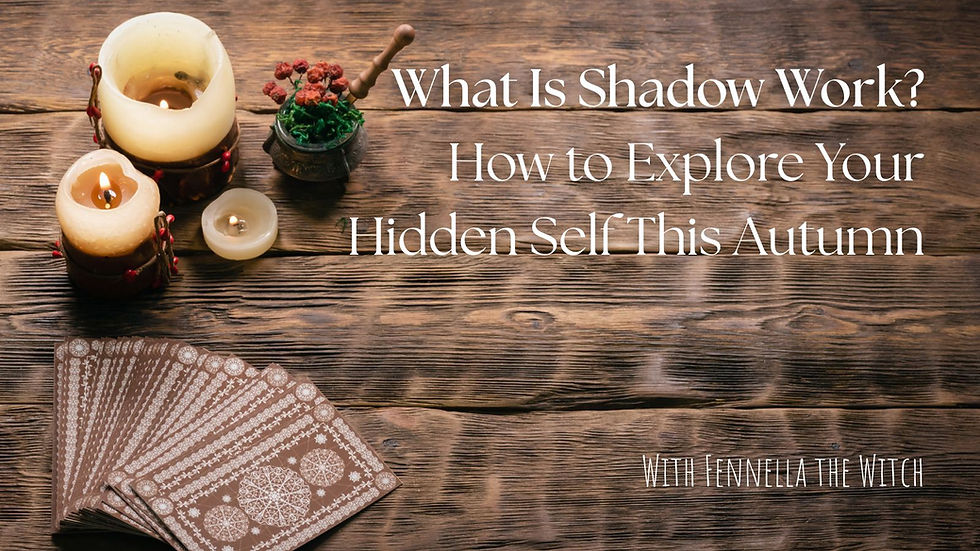
Autumn is a season of change, reflection, and letting go - and it’s the perfect time to explore shadow work.
Shadow work is the practice of uncovering and integrating the parts of yourself that you usually avoid, hide, or deny. For witches and spiritual seekers, it’s a powerful way to connect with your inner self, release old patterns, and step into your full potential. In this guide, I’ll share how to use simple yet effective practices like journaling, tarot, and nature walks to explore your shadow this autumn, along with tips for self-care and staying grounded while doing deep inner work.
Whether you’re a beginner or returning to shadow work, these seasonal strategies can help you uncover hidden truths, set boundaries, and grow in authenticity.
What Is Shadow Work?
At its heart, shadow work is the practice of exploring and integrating the parts of ourselves we usually avoid. These might be traits we’ve learned are “bad,” emotions we’d rather not feel, or even hidden strengths we’ve convinced ourselves we don’t deserve.
The phrase comes from the psychologist Carl Jung, who described the “shadow” as the hidden side of the self. In witchcraft, we can think of shadow work as meeting our whole selves, not just the shiny parts we’re comfortable sharing.
Shadow work isn’t about punishment, shame, or tearing ourselves apart - It’s about self-discovery and balance. By sitting with our shadow instead of running from it, we uncover truths that help us grow into our full power.

Why Autumn Is the Perfect Time for Shadow Work
Autumn has always carried the energy of release. The trees shed their leaves, fields are cleared after the harvest, and the long, bright days give way to earlier sunsets. Nature shows us that letting go is not an ending, but part of the cycle of growth - a pause before renewal.
Despite that lovely imagery, I’ll be honest: I’ve often struggled with autumn.
I dread the cold, dark winters so much that as soon as the nights begin to lengthen, I feel that familiar panic rising. For many years I was so caught up in this fear that I barely noticed the beauty of the season unfolding around me.
But in its own way, that’s exactly what shadow work is about.
It’s the practice of acknowledging, and even learning to appreciate, the darker places within ourselves. Instead of running from what feels uncomfortable, shadow work invites us to stay present with it, to search for the hidden beauty we might otherwise overlook.
This makes autumn a powerful season for shadow work. As the nights grow longer, we’re naturally drawn inward, with more time for reflection and quiet. The shift in the air feels like an invitation to slow down, listen, and face what we’ve been carrying.
People have long considered this as the season when the veil grows thin, making it easier to connect with our ancestors and spirits - why not the darker parts of ourselves too? Just as we honour those who came before us, shadow work invites us to honour the forgotten or unacknowledged parts of our own being.
Autumn helps us approach shadow work not with fear, but with a sense of rhythm, belonging, and transformation.
How I Practise Shadow Work (And How You Can Try It Too)
For me, shadow work has always worked best when it’s simple and woven into everyday life. I don’t need a big rituals or expensive tools, just a way to meet myself honestly.
Here are the practices I return to again and again, especially in autumn:
Journaling
I’ve kept a journal since I was a teenager, and it’s probably the most consistent way I’ve explored my shadow. At some point when I was a student I did The Artist’s Way - and the only thing I really remember from it was the Morning Pages. The practice is simple: you write three full pages of whatever’s in your head first thing in the morning.
I don’t keep that practice up anymore (I have a toddler, so writing in the morning is not a thing!), but I do journal most nights before bed. I’ve found that sticking to the “three pages” rule is fantastic for helping me get to the root of my thoughts. The first page is usually clutter and surface noise, the second digs deeper, and by the third page, I often uncover something I didn’t realise I was carrying.
If you’d like to try this yourself, grab a notebook tonight and aim for three messy, unfiltered pages. Don’t overthink it, don’t edit yourself - just let the words spill out. That’s where the shadow starts to reveal itself.
Side tip - the thing that helped me start journaling regularly was going to bed slightly earlier.
I realised that the last hour of me forcing my eyes open to watch something on telly I did not care about in the name of “me-time”, was far better spent washing my face, moisturising, and scribbling in my journal.
Tarot
Tarot is another shadow work tool I return to again and again.
My deck usually lives on my desk, so I often end up pulling cards casually through the day when I feel stuck. It’s also useful when I sit down to journal and can’t quite find the words - pulling a card will unlock something. If I don’t know what to write about, I’ll pull a card and let it lead me.
It doesn’t always have to be deep or heavy - sometimes it just gives me an image or phrase to begin with. But of course, you can also ask really pointed shadow questions if you’re ready for that. Things like:
What part of myself am I avoiding right now?
What truth do I not want to face?
What is the gift hidden in this shadow?
When I give myself permission to sit with the card and be honest about what it stirs up, I always find a thread I can follow.
And if you’d like more structure than a casual draw, I’ve created an Autumn Tarot Workbook with spreads and prompts designed especially for this season of reflection and shadow work.
Nature Walks
The last practice I lean on is walking.
Autumn walks are a favourite of mine - even though I struggle with the season, being out in the fresh air, among the falling leaves helps me feel sane.
One thing I’ve learned for shadow work: no headphones.
When I walk in silence, I don’t get to drown out the noise in my head - I have to listen to it. Sometimes (okay - often) that’s uncomfortable, but that’s the point. Shadow work isn’t about escaping ourselves, it’s about noticing what’s really there.
If you’d like to try it, pick a route, get your boots on, and get outside. Notice what rises in your mind as you walk, and what catches your eye in the world around you. Be present with your surroundings, and surrender to the thoughts in your head.
When things are bad, and my mind is racing, I find it grounding to simply watch the leaves fall - or to see them, dead on the ground, already turning to soil. It reminds me that everything is temporary, and that this too shall pass.
Self-Care
Shadow work can stir up emotions you weren’t expecting, or weren't as ready as you thought to confront.
That’s normal, and it doesn’t mean you’re doing it wrong, it just means you’re paying attention to parts of yourself that you usually try to ignore.
For me, being kind to yourself is part of shadow work.
The great thing about autumn is how much opportunity there is to get comfy and cosy. Wrap yourself in a warm blanket, light a candle, make a cup of tea, or literally just give yourself mental permission to rest (and maybe watch some Gilmore Girls). Little acts like these help hold you while heavier emotions come up, reminding you that you don’t have to rush the process - and that where you are right now is okay, and safe.
It’s also important to remember that shadow work doesn’t replace professional support. If you feel that the emotions you’re uncovering are too heavy to manage alone, pairing your witchy practices with therapy or counselling can provide safety and guidance. Shadow work is about meeting yourself fully, but you don’t have to do it alone.
Why Practice Shadow Work?
If shadow work can stir up so much discomfort, you might be wondering: like, why even bother?
Over the past year, I’ve been doing a lot of work on showing up authentically. I have what I think of as a really good “smiley, everything-is-okay, I-can-do-anything” work-face - and I’ve been consciously noticing when I put it on, and when I take it off. What I realised is that I had stopped taking it off, even with friends, family, and at home, and that it was exhausting and making me utterly miserable.
Shadow work has helped me explore the difference between who I want to show up as professionally, and who I want to be as a human, as a friend, daughter, sister, wife, mother.
It’s allowed me to set boundaries, to notice when I’m leaning into the parts of myself that are performative rather than authentic, and to step more fully into who I’m meant to be.
Through shadow work, I realised that I had built my “work-mask” to cover all the parts of myself I thought might make others uncomfortable. What I’ve learned by taking it off is that there’s a really strong, really cool lady underneath - and the people who love me, love me with all my flaws, and genuinely want me to be happy and honest. The people who prefer me agreeable and silently miserable? They weren’t meant to have my attention in the first place.
Happy Autumn
Shadow work isn’t always easy.
It can stir up emotions, challenge old habits, and make you confront parts of yourself you’ve long avoided. But as I’ve discovered, it’s also incredibly rewarding. It helps you step into your power, set boundaries, and show up more authentically.
Autumn is the perfect season for this kind of inner work. The natural rhythm of letting go, reflection, and turning inward mirrors the process of shadow work, making it a gentle and supportive time to explore yourself more deeply.
For the first time in years, I’m genuinely excited for autumn this year! I can’t wait to see who I will be when I emerge from the dark months next Spring!
If you’d like some extra guidance, I’ve put together a few seasonal tools:
Autumn Tarot Workbook (£4.50) — with spreads and prompts to explore your shadow through the cards.
Autumn Shadow Video Readings (from £11) — personalised insight for your seasonal reflection.
Full Shadow 1:1 Tarot Session (£35) — a deeper, guided journey through your shadow with tarot.
Whether you try journaling, tarot, nature walks, or one of these resources, remember: you don’t have to rush, you don’t have to get it “right,” and where you are right now is okay and safe.
Let this autumn be a season of curiosity, reflection, and self-discovery.


Comments